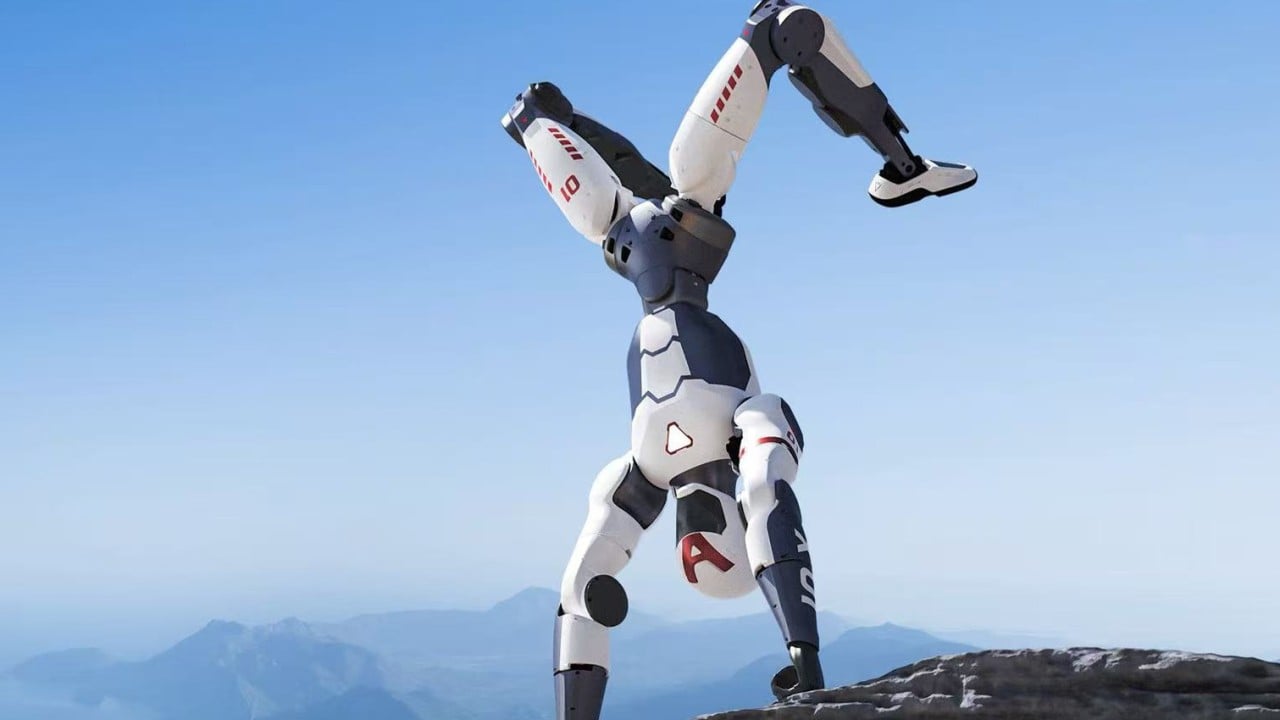
The delivery truck pulls away, leaving a silent, rectangular crate on the gravel. It looks like a high-end refrigerator or perhaps a new mountain bike. But as the lid comes off, the sunlight catches a metallic sheen that feels entirely different from a kitchen appliance. This is the Unitree G1. It is sixty pounds of joints, sensors, and wires, and it costs about as much as a used Honda Civic.
For decades, the dream of a mechanical servant was a luxury for the ultra-wealthy or a prop for a high-budget film. You watched them on YouTube—sleek, multimillion-dollar prototypes performing backflips in clean laboratory settings. They were marvels of engineering, yes, but they were also ghosts. You couldn't touch them. You certainly couldn't buy one.
Now, the barrier has collapsed.
China’s Unitree has moved from the laboratory to the digital storefront, listing its latest humanoid robot on Alibaba for a price point that undercuts almost every Western competitor. At roughly $16,000, the G1 isn’t just a piece of tech. It is a signal. It tells us that the era of the "expert-only" robot is dying. The era of the consumer humanoid has begun.
The Weight of a Handshake
Consider a man named Arthur. He lives alone in a suburban house that is slowly becoming too much for him to manage. His knees ache when he reaches for the high shelves. The simple act of folding laundry is a chore that steals thirty minutes of his dwindling energy every evening. To Arthur, a robot isn't a sci-fi trope. It’s an extra pair of hands.
When Arthur looks at the G1, he isn't seeing "advanced degrees of freedom" or "force-controlled actuators." He is looking at the possibility of a roommate that doesn't sleep. The G1 stands about four feet, three inches tall. It is compact, designed to be folded into a package no larger than a carry-on suitcase.
When it unfolds, it reveals a face that is actually a sophisticated array of sensors. A 3D LiDAR system spins silently, mapping the room in real-time. It sees the coffee table Arthur always trips over. It sees the stray cat darting across the floor. Unlike the clumsy vacuum pucks of the last decade, this machine understands verticality. It understands that a house is a three-dimensional puzzle.
The real magic, however, is in the hands. The G1 is offered with an optional three-fingered hand that mimics human dexterity. It can exert pressure or move with extreme delicacy. Think about the strength required to crack an egg without pulverizing it. That is the threshold Unitree is crossing. They are moving past machines that merely move heavy things to machines that can manipulate the world with grace.
The Price of Admission
There is a specific kind of tension that exists when a technology becomes affordable. When the first computers filled entire rooms, they were tools for the state. When they shrunk to fit on a desk, they became tools for the mind. Now that humanoids are shrinking to fit a middle-class budget, they are becoming tools for the home.
The $16,000 price tag is a hand grenade thrown into the robotics market.
Competitors in the United States and Europe are often developing machines that cost six figures. They are built with the assumption that only massive factories or research universities will ever own them. Unitree is betting on a different reality. By leveraging the sprawling manufacturing infrastructure of China and selling through a platform as ubiquitous as Alibaba, they are aiming for volume.
This isn't a boutique item. It is a commodity in the making.
But we must ask ourselves what we give up for that price. A lower price point often means shorter battery life or less durable materials. The G1 runs for about two hours on a single charge. In the grand scheme of a human day, two hours is a blink. It’s enough time to prep a meal and clear the table, but it isn’t enough to be a constant companion. Not yet.
We are in the "dial-up" phase of robotics. It is slow, it is slightly awkward, and it requires a fair bit of patience. Yet, if you remember the screeching sound of a modem in 1996, you know what follows. The clunky beginnings are always the foundation for the things we eventually cannot live without.
The Invisible Stakes
Why does it matter if a robot can walk on two legs? Why not just use wheels?
Our world is built for humans. The height of a countertop, the width of a doorway, the rise of a staircase—these were all decided by the dimensions of the human body. A wheeled robot is a prisoner of the ground floor. A humanoid robot is a citizen of the house.
This is the psychological bridge we are crossing. When a machine shares our form, we begin to project intent onto it. We stop seeing it as a tool and start seeing it as a presence. This is where the emotional core of the technology lies.
For someone like Arthur, the arrival of a G1 isn't just about the labor it performs. It’s about the shift in the atmosphere of a quiet home. There is something moving in the corner of the eye. There is a sense of "someone" being there. This can be comforting, or it can be profoundly unsettling.
Unitree’s push into the mass market forces us to deal with these feelings now rather than in some distant future. We have to decide what it means to have a mechanical entity navigating our private spaces. Is it an invasion of privacy? Or is it the ultimate expression of autonomy for the elderly and the disabled?
The Mechanics of the Soul
Behind the hype of the Alibaba listing lies a complex web of "Imitation Learning" and "Reinforcement Learning." These are the brains of the G1.
In the old days, you had to program every single movement. If you wanted the robot to pick up a cup, you had to write lines of code for the shoulder, the elbow, the wrist, and the fingers. It was tedious. It was prone to failure.
The G1 learns differently. It watches.
Through simulated environments, these robots "practice" a task thousands of times in a virtual world before they ever attempt it in the real one. They fail. They fall. They drop the cup. But they do it at the speed of a processor, not the speed of a human. By the time the robot arrives at your house, it has already "lived" a thousand lifetimes of trial and error.
This is how Unitree manages to keep the cost down. They aren't just selling you hardware; they are selling you the distilled experience of a million virtual failures. The intelligence is a software update away. Today it can walk; tomorrow, a download might teach it how to fold a shirt.
The Silent Revolution
There is a specific silence that accompanies a major shift in human history. It isn't a bang. It’s the sound of a new item appearing on a digital menu. It’s the sound of a credit card being swiped for a purchase that would have been impossible five years ago.
The G1 isn't perfect. It is short. Its battery life is limited. It might struggle with the complex texture of a shag carpet. But it is here.
We often think of the future as something that happens to us, a wave that crashes on the shore while we stand helpless. But the future is actually a series of small choices made by people in rooms. It’s an engineer in Hangzhou deciding to swap a titanium part for a high-strength alloy to save costs. It’s a logistics manager figuring out how to ship a humanoid robot as "standard freight."
The stakes are invisible because they are domestic. This isn't about robots taking over the world in a violent uprising. It’s about robots taking over the mundane tasks that eat our lives. It’s about the liberation of time.
If Arthur can save thirty minutes a day because his aluminum stranger handles the chores, that is a victory. If a thousand Arthurs can stay in their homes longer because they have mechanical assistance, that is a revolution.
The price of a humanoid has finally met the reality of a household budget. The crate is on the doorstep. The lid is off. The machine is waiting for its first command. We are no longer looking at the horizon. We are looking at the living room floor.