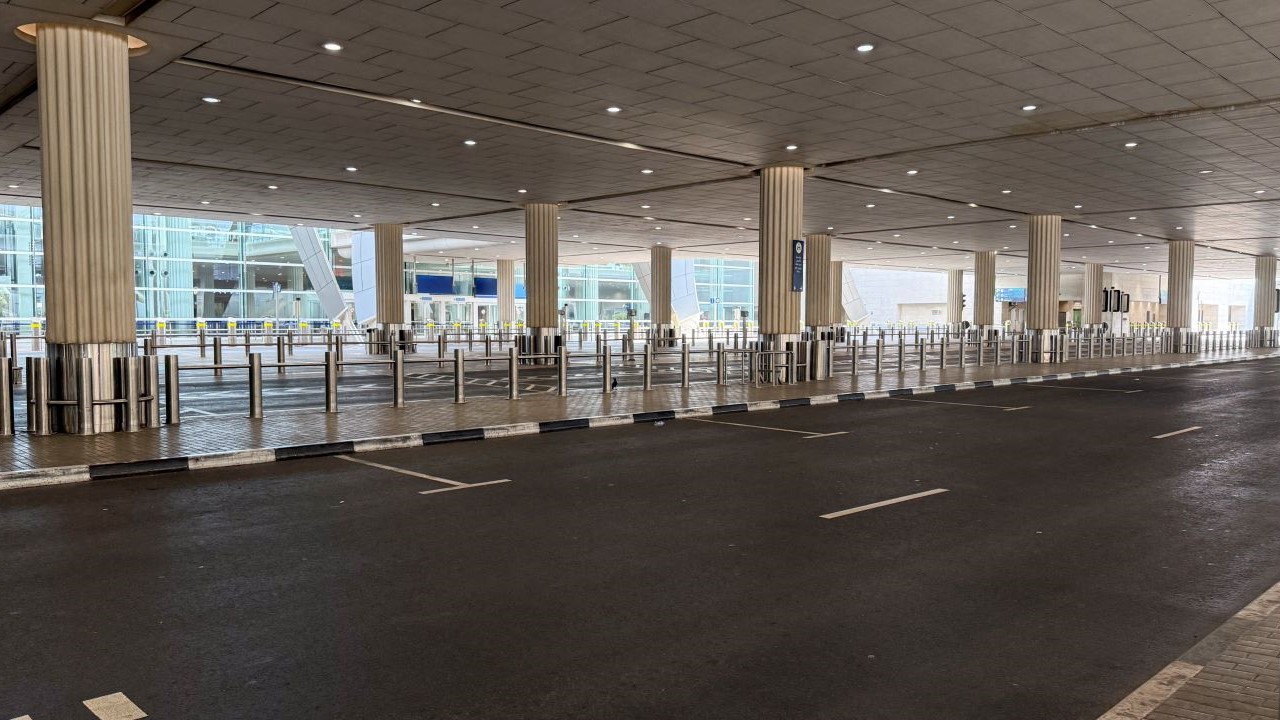
The silence was the first sign that something had gone wrong.
At Dubai International Airport, silence is a mathematical impossibility. It is a place defined by the rhythmic, mechanical pulse of the world—the bass-heavy roar of GE90 engines, the frantic trilingual chirp of terminal announcements, and the steady, metallic thrum of air conditioning fighting back the desert heat. It is a cathedral of kinetic energy where a plane takes off or lands nearly every ninety seconds.
On this particular afternoon, that pulse stopped.
Sarah, a fictionalized composite of the thousands sitting in Terminal 3, was watching the digital clock. She had a connection to London. She had a presentation to give. She had a life measured in layover minutes. When the giant display boards suddenly flushed from a sea of green "On Time" statuses to a monolithic, blinking amber "Delayed," the collective intake of breath from three hundred passengers sounded like a vacuum seal breaking.
Then came the word: "Suspended."
Outside the glass, the runways—usually a choreographed ballet of aluminum giants—were eerily empty. In the distance, a line of Emirates A380s circled the desert like vultures, burning through thousands of gallons of Jet A-1 fuel, waiting for a command that wouldn't come.
The cause wasn't a sandstorm. It wasn't a mechanical failure or a security breach in the traditional sense. It was a toy. Or rather, something that looked like a toy, weighing less than a carry-on bag, dancing in the restricted airspace where it didn't belong. A single unauthorized drone had turned the world’s busiest international hub into a high-stakes parking lot.
The Invisible Wall in the Clouds
When a drone enters an airport’s protected envelope, it isn't just a nuisance. It is a kinetic threat. To an engine spinning at 10,000 RPM, a lithium-ion battery and a carbon-fiber frame are not mere plastic; they are shrapnel.
Pilots call it "the gap." It’s that terrifying moment of vulnerability during takeoff or final approach where there is no room for error. If a drone hits a cockpit windshield at 200 knots, the result isn't a cracked window; it’s a catastrophic breach. This is why the decision to halt operations is instantaneous and absolute. There is no "middle ground" when you are responsible for 500 souls on a double-decker jet.
For the authorities in the tower, the frustration is visceral. They can see the intruder on specialized radar—a tiny, defiant blip mocking a multi-billion dollar infrastructure. But finding the pilot? That is like hunting for a ghost in a mirage. The operator could be miles away, tucked into the shade of a parking garage or sitting in a suburban living room, blissfully or maliciously unaware of the chaos they have unleashed.
The Mathematics of Chaos
The disruption lasted for a little over an hour. In the grand scheme of a human life, sixty-nine minutes feels like a long lunch. In the world of global logistics, it is a localized earthquake.
Consider the ripple effect. When Dubai closes, the world stutters. Flights bound for the UAE from Hong Kong, London, and New York were diverted to neighboring airports like Al Maktoum or Sharjah. This isn't as simple as taking a different exit on the highway.
Each diversion requires a new flight plan, more fuel, and fresh crew hours. Pilots have "duty clocks"—strict legal limits on how long they can stay awake and fly. When a flight is diverted and sits on a hot tarmac for three hours waiting for Dubai to reopen, the crew often "times out." They are legally forbidden from flying the final leg.
Suddenly, you have a plane in the wrong city, a crew that needs a hotel, and five hundred passengers who are missing their weddings, their funerals, and their multi-million dollar business Closings.
The financial bleed is staggering. Estimates suggest that every minute of downtime at a major hub like Dubai costs the economy roughly $1 million. That single hour of "recreational" drone flight likely carried a price tag north of $60 million. But the true cost isn't found in the ledgers of the airlines. It’s found in the faces of the people leaning against the cold marble pillars of the terminal.
The Human Cost of a Digital Intrusion
Sarah didn't care about the $60 million. She cared about the fact that her phone was dying and her daughter’s choir recital started in eight hours.
The atmosphere in a shut-down airport evolves through predictable stages. First, there is the confusion—the frantic checking of apps and the squinting at screens. Then comes the communal bonding, where strangers share portable chargers and rumors. Finally, a heavy, stagnant exhaustion sets in.
People began to realize that their lives were being dictated by someone they would never meet. The sheer asymmetry of the power is what stings. One person with a $1,000 gadget had successfully paralyzed the travel plans of nearly 30,000 people.
It highlights a terrifying new reality in our technological evolution: the ease of disruption. We have built a world that is incredibly efficient but remarkably brittle. Our most advanced systems are often the most vulnerable to the simplest interventions. It is the digital equivalent of a pebble stopping a landslide.
The Hunt for the Ghost
Security teams at Dubai International are not spectators. They employ some of the most advanced counter-drone technology on the planet. This includes "geofencing"—software locks that are supposed to prevent drones from flying near airports—and "signal jamming," which attempts to sever the link between the drone and its pilot.
But technology moves faster than regulation.
Custom-built drones can bypass geofencing. Frequency-hopping controllers can dodge jammers. The authorities are engaged in a permanent arms race against hobbyists and bad actors. In this specific instance, the drone eventually vanished or its battery died, allowing the "all clear" to be given. But the damage was done. The ghost had won the afternoon.
The UAE has since implemented some of the strictest drone laws in the world. Registration is mandatory. Flying near an airport can result in massive fines and years in prison. Yet, the incidents persist. Why? Because the barrier to entry is too low and the thrill of "getting the shot" is too high for the reckless.
The Echoes of a Restart
When the runways finally reopened, the sound returned with a vengeance.
The engines roared back to life, but the rhythm was off. The ballet was now a scramble. Air traffic controllers, who are often the unsung heroes of these crises, had to thread the needle of hundreds of delayed arrivals and departures. They had to manage the "flow" to ensure the sky didn't become overcrowded while trying to get everyone home.
Sarah eventually boarded her flight, six hours late. She watched the desert floor recede through the oval window, looking for a speck in the air, a tiny quadcopter that might be lurking in the clouds. She felt a new kind of anxiety—a realization that the "frictionless" world we’ve been promised is a fragile illusion.
We live in an age where the sky is no longer a sanctuary. We have populated the heavens with our toys and our tools, often forgetting that they share the same space. The drone strike at Dubai wasn't an explosion of fire and metal. It was an explosion of inconvenience, a reminder that in our hyper-connected reality, one small, unauthorized signal can bring the giants of the earth to a grinding, silent halt.
The sun set over the Persian Gulf, casting long, orange shadows across the tarmac. The planes were moving again. The screens were green. The pulse had returned. But for those who sat on the floor of Terminal 3, the silence of that hour still echoed. It was a reminder that we are only as fast as our most vulnerable link, and currently, that link is a spinning plastic blade in the hands of a stranger.
The lights of the city began to twinkle, millions of tiny electronic eyes looking up at a sky that felt just a little bit smaller than it did that morning.