The People’s Republic of China (PRC) has transitioned from a phase of opportunistic technology acquisition to a multi-decade industrial siege aimed at dismantling the Boeing-Airbus duopoly. The 14th Five-Year Plan for civil aviation does not merely outline production targets for the Comac C919; it establishes a framework for technical sovereignty by attempting to decouple the domestic supply chain from Western Original Equipment Manufacturers (OEMs). This objective is governed by three primary structural constraints: the propulsion bottleneck, the certification lag, and the economies of scale required for global cost parity.
The Triad of Sovereign Aviation Development
China’s civil aviation trajectory is defined by a three-tiered hierarchy of needs. Success in the first tier is a prerequisite for progression to the subsequent stages.
- Platform Maturity (C919 and ARJ21): Proving that a domestic airframe can operate safely and reliably within a high-tempo commercial environment.
- Subsystem Indigenization (The CJ-1000A): Replacing critical Western components—most notably the engines and avionics—with domestic alternatives to mitigate geopolitical risk.
- Market Penetration and Infrastructure: Expanding the global footprint through the Civil Aviation Administration of China (CAAC) certification pathways and Belt and Road Initiative (BRI) partnerships.
The Propulsion Bottleneck and the CJ-1000A Program
The C919 currently relies on the CFM LEAP-1C, a product of the GE-Safran joint venture. This creates a strategic vulnerability. If Western export licenses were revoked, the C919 program would cease production immediately. To resolve this, the Aero Engine Corporation of China (AECC) is developing the CJ-1000A.
Developing a high-bypass turbofan is a feat of material science rather than simple assembly. The "hot section" of an engine requires single-crystal turbine blades capable of withstanding temperatures exceeding the melting point of the metal itself. China has historically struggled with the consistency of these superalloys. The transition from the LEAP-1C to the CJ-1000A represents a shift from a known performance variable to an unproven domestic platform. Even if the CJ-1000A achieves initial flight certification by 2027, it will lack the decades of reliability data that allow Western engines to offer low Total Cost of Ownership (TCO) through extended Time Between Overhauls (TBO).
Certification as a Non-Tariff Barrier
The CAAC has certified the C919, but the aircraft lacks validation from the Federal Aviation Administration (FAA) or the European Union Aviation Safety Agency (EASA). Without these stamps of approval, the C919 is effectively restricted to Chinese domestic airlines and a handful of secondary markets that recognize CAAC standards.
This creates a "certification island." While China’s domestic market is large enough to sustain initial production runs, it cannot achieve the unit-cost reductions found in the Boeing 737 or Airbus A320 programs without global volume. The absence of FAA/EASA certification also impacts the resale value and "bankability" of the aircraft. International leasing firms—which fund the majority of global aircraft purchases—require standardized certification to ensure the asset can be easily moved between jurisdictions. Until Comac bridges this regulatory gap, the C919 remains a regional tool rather than a global competitor.
The Industrialization of Comac
The 5-year goal of reaching an annual production capacity of 150 C919 units by 2028 is an aggressive attempt to move past the "artisanal" phase of manufacturing.
The Learning Curve in Aerospace Manufacturing
In aerospace, the "learning curve" dictates that the labor hours required to produce a unit decrease by a fixed percentage every time cumulative production doubles. Boeing and Airbus have optimized these curves over sixty years. Comac is currently at the steepest part of the curve.
- Supply Chain Fragmentation: Currently, over 60% of the C919’s major components are sourced from Western Tier 1 suppliers like Honeywell, Rockwell Collins, and Parker Aerospace.
- Final Assembly Line (FAL) Optimization: Increasing output from single digits to 150 per year requires a transformation from manual station-based assembly to a moving line flow. This demands a level of "just-in-time" logistics that China’s domestic aerospace supply chain has yet to demonstrate at scale.
The risk here is a "quality-volume trade-off." Rapidly scaling production often introduces defects that do not appear in low-volume prototypes. For Comac, a single high-profile safety incident involving a domestic airframe would set the indigenization goal back by a decade.
Capital Allocation and State Subsidies
The C919 is not a product of market forces; it is a product of state-directed capital. Estimates suggest upwards of $70 billion has been injected into Comac. This removes the immediate pressure of profitability but creates a long-term efficiency problem. When capital is essentially free, there is less incentive to optimize the manufacturing process for cost-efficiency. This "subsidy trap" makes the aircraft attractive to state-owned Chinese carriers but difficult to sell to private international airlines that operate on razor-thin margins and prioritize fuel burn and maintenance costs above all else.
The CR929 and the Wide-Body Ambition
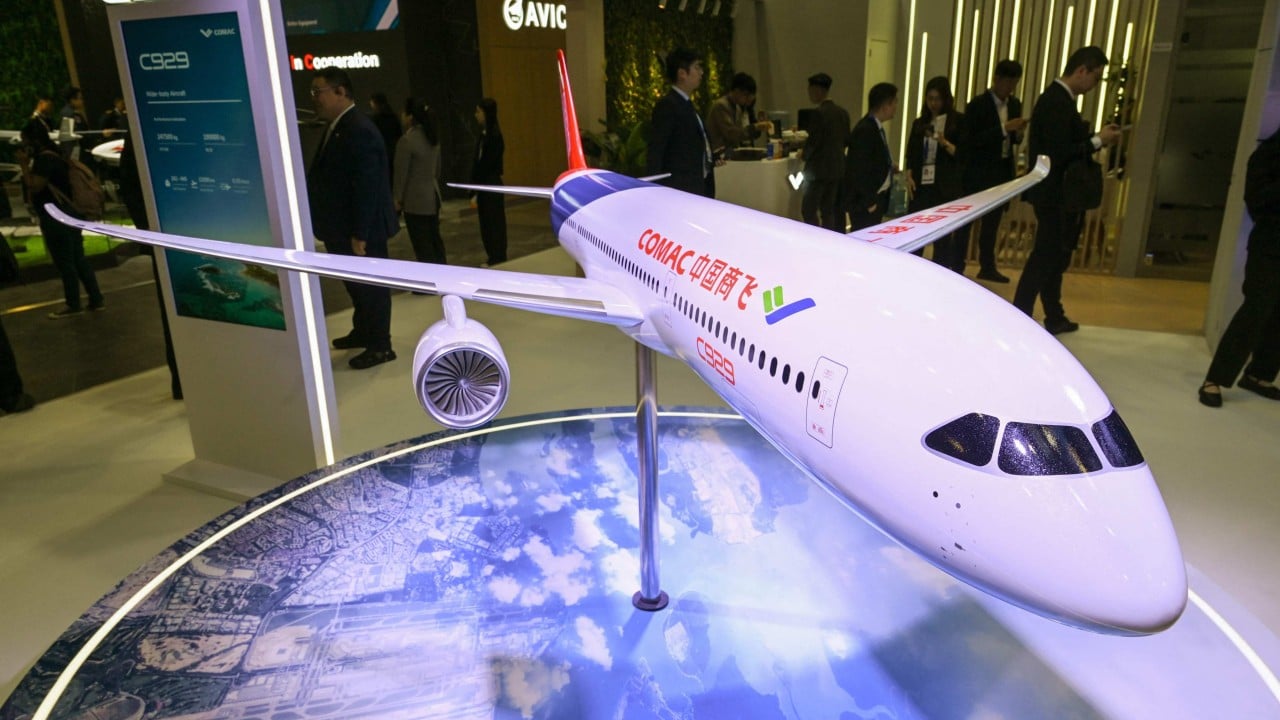
While the C919 targets the narrow-body market (the "workhorse" of aviation), the CR929 (now rebranded as C929 following Russia’s diminished role) targets the long-haul, wide-body segment. This is where the highest profit margins exist.
Developing a wide-body aircraft involves exponential increases in complexity.
- Carbon Fiber Composites: Wide-bodies require extensive use of carbon fiber reinforced polymers (CFRP) to reduce weight and increase fuel efficiency. While China is a leader in industrial carbon fiber, aerospace-grade CFRP requires specific resin-transfer molding techniques that are highly guarded trade secrets.
- The Russian Exit: Russia’s UAC was originally the partner for wing design and materials. Following the invasion of Ukraine and subsequent sanctions, China has had to pivot to a solo development path. This has delayed the program but arguably simplified the intellectual property (IP) architecture, allowing China to claim 100% "proprietary" status once the aircraft eventually flies.
Geopolitical Friction and the Bifurcation of Aviation
The aviation industry is moving toward a "Bipolar Supply Chain." We are seeing the emergence of two distinct spheres of influence.
- The Western Bloc: Centered on FAA/EASA standards and Boeing/Airbus platforms.
- The Sino-Centric Bloc: Centered on CAAC standards, Comac platforms, and a supply chain that bypasses the US dollar and US export controls.
For nations in the Global South, the C919 offers a diplomatic and financial alternative. China can bundle aircraft sales with infrastructure loans, pilot training programs, and diplomatic favors. This "Aviation-as-a-Service" model allows China to export its regulatory standards alongside its hardware. If a nation adopts the C919, its entire aviation ecosystem—maintenance, repair, and overhaul (MRO), air traffic control, and pilot certification—becomes tethered to Beijing.
Strategic Forecast: The Decade of Incrementalism
The next five years will not result in a "game-changing" displacement of Boeing or Airbus. Instead, we will observe a process of "enforced adoption."
The three major Chinese state-owned carriers (Air China, China Southern, and China Eastern) will be mandated to integrate the C919 into their fleets regardless of initial operational inefficiencies. This creates a captive "proving ground" where Comac can iterate on the design and iron out maintenance issues without the risk of bankruptcy.
The real metric of success is not the number of orders—which are currently dominated by state-linked entities—but the Dispatch Reliability rate. If the C919 can maintain a 99% dispatch reliability over three years of high-utilization service, it will have overcome the primary hurdle to international legitimacy.
The second critical metric is the CJ-1000A flight test hours. The gap between a "working engine" and a "commercial engine" is measured in millions of flight hours. Until that engine is proven, China’s 5-year goals remain a fragile architecture built on Western foundations.
The tactical move for Western stakeholders is to monitor the "indigenization percentage" of Comac's Tier 2 and Tier 3 suppliers. As China moves from assembling Western parts to manufacturing its own fasteners, sensors, and actuators, the window for Western influence over the program closes. The goal for China is not just to build a plane, but to build the machine that builds the plane, independent of external leverage.