The screen flickers. A single candle of green light on a trader’s monitor in a darkened office in Greenwich or perhaps a sleek high-rise in Singapore. It is a quiet moment, the kind where the rest of the world is worrying about the price of eggs or the latest political gaffe. But in this silence, someone is moving a mountain. They are doing it with a series of keystrokes that represent $800 million.
Most people cannot visualize $800 million. It is an abstraction, a number so large it loses its teeth. To put it in perspective, if you spent $1,000 every single day, it would take you over 2,000 years to burn through that pile. Yet, in the frantic, shadow-drenched hours before Donald Trump took to a stage to announce his latest policy shift, that exact amount of capital moved with surgical precision.
It wasn't a random swell of market optimism. It wasn't a "rising tide lifting all boats." It was a laser-guided strike.
When money moves like that, it leaves a scent. To the uninitiated, the stock market looks like a chaotic sea of red and green. To those who spend their lives staring at the tape, it looks like a crime scene. This isn't just about finance; it is about the fundamental erosion of the "fair shake." It is the moment the house stops being a neutral venue and starts playing with loaded dice.
The Mechanics of the Unfair Advantage
Imagine you are playing a game of poker. You have studied the odds. You know the math. You’ve managed your bankroll with discipline. Across the table sits a man who hasn't looked at his cards once. He is grinning. He bets his entire life savings before the dealer even touches the deck. Why? Because he already knows the flop. He knows the turn. He knows the river.
In the world of high-finance, we call this "front-running." In the world of ethics, many are starting to call it treason.
The trades in question targeted specific sectors—industries that stood to gain or lose everything based on the specific words the former President was about to utter. This isn't just "good intuition." You don't bet $800 million on a hunch. That kind of capital requires certainty. It requires the kind of knowledge that only exists in the inner sanctum of power, where policy is whispered into existence long before it is shouted into a microphone.
When we see these spikes, we are seeing the ghost of a secret. The $800 million didn't just appear; it was diverted from the pockets of everyone else. For every person who "won" by knowing the announcement was coming, thousands of retail investors—teachers, firefighters, and small business owners—lost. They were the ones on the other side of those trades, selling when they should have held, or buying when the price was already artificially inflated.
The Human Cost of a Fixed Race
Let’s look at a hypothetical investor. We’ll call him Elias. Elias is sixty-two. He lives in a modest suburb and spends his weekends tinkering with a vintage motorcycle he hopes to one day ride across the country. He has a 401(k) that he checks once a month. He trusts the system because he has to. He believes that if he works hard and follows the rules, the market will, over time, reward his patience.
On the day of the $800 million surge, Elias sees a bit of movement in his energy stocks. He thinks, Maybe I should sell a little to lock in some gains for that motorcycle trip. He sells. Two hours later, the announcement drops. The stocks rocket upward. Elias didn't just miss a rally; he was fleeced by someone who knew the rally was a mathematical certainty.
Elias isn't a victim of "market volatility." He is a victim of an information heist.
This is where the word "treason" starts to vibrate with a different kind of intensity. Usually, we reserve that word for selling state secrets to a foreign power. But what do we call it when the internal mechanisms of a democracy are used to enrich a select few at the direct expense of the citizenry? If the integrity of the market is a pillar of national stability, then blowing a hole in that pillar for a payday is an act of institutional sabotage.
The Data Doesn't Lie
Critics often argue that these movements are just "market anticipation." They claim that savvy analysts can predict what a politician will say based on previous rhetoric. But the data tells a different story.
$800 million represents a volume that dwarfs "anticipation." Standard analytical models, which factor in historical volatility and typical pre-announcement behavior, show this specific surge as a statistical impossibility. It is an outlier among outliers. In any other context—say, a lab experiment or a professional sports league—this would trigger an immediate, scorched-earth investigation.
The complexity of these trades is also a smoking gun. They weren't just simple "buy" orders. They were sophisticated combinations of options and derivatives designed to maximize profit while minimizing the digital footprint. This wasn't a lucky amateur. This was an architect.
Consider the timing. The bulk of the volume hit the tapes in a narrow window—minutes before the news cycle began to churn. If you plotted the timeline of the trades against the timeline of the physical movement of the announcement draft, the lines wouldn't just be parallel. They would be identical.
The Eroding Trust
Money is, at its core, a belief system. We work for it, save it, and trade it because we believe it has a set value and that the rules governing its movement are relatively consistent. When $800 million moves on a "whisper," that belief system begins to crack.
Why should a young person start an IRA if the "big players" can see through the back of the cards? Why should anyone participate in a system where the outcome is decided in a green room before the cameras even start rolling?
The real danger of this $800 million trade isn't the wealth gap it creates, though that is significant. The danger is the cynicism it breeds. A cynical public is a brittle public. When people lose faith in the fairness of their institutions, they stop looking for ways to improve them and start looking for ways to burn them down.
We have seen this pattern before. History is littered with examples of "insider" classes who thought they could skim off the top forever without anyone noticing. They always think they are being subtle. They always think the $800 million is just a drop in the ocean. But the ocean eventually notices when the tide is being pulled out by a giant, invisible hand.
The Shadow of the Law
The legal battle over these trades will likely drag on for years. Lawyers will argue over the definition of "non-public information." They will hide behind the complexity of high-frequency trading algorithms. They will claim that the $800 million was simply the result of "convergent brilliance"—the idea that many smart people all happened to have the same idea at the exact same second.
But we know better.
The law is often a slow, lumbering beast, trailing far behind the speed of a fiber-optic cable. By the time a regulator finishes a report, the money has been washed through a dozen different jurisdictions and parked in an offshore account. The profit is locked in. The "cost of doing business"—usually a fine that represents a fraction of the gain—is paid with a smirk.
This is the cycle that has to break. If we treat these events as mere "regulatory hurdles" or "controversial trading patterns," we miss the point. We are talking about the soul of the economy. We are talking about whether or not a word given by a public official is a tool for the public good or a signal for a private payday.
A Silence That Speaks
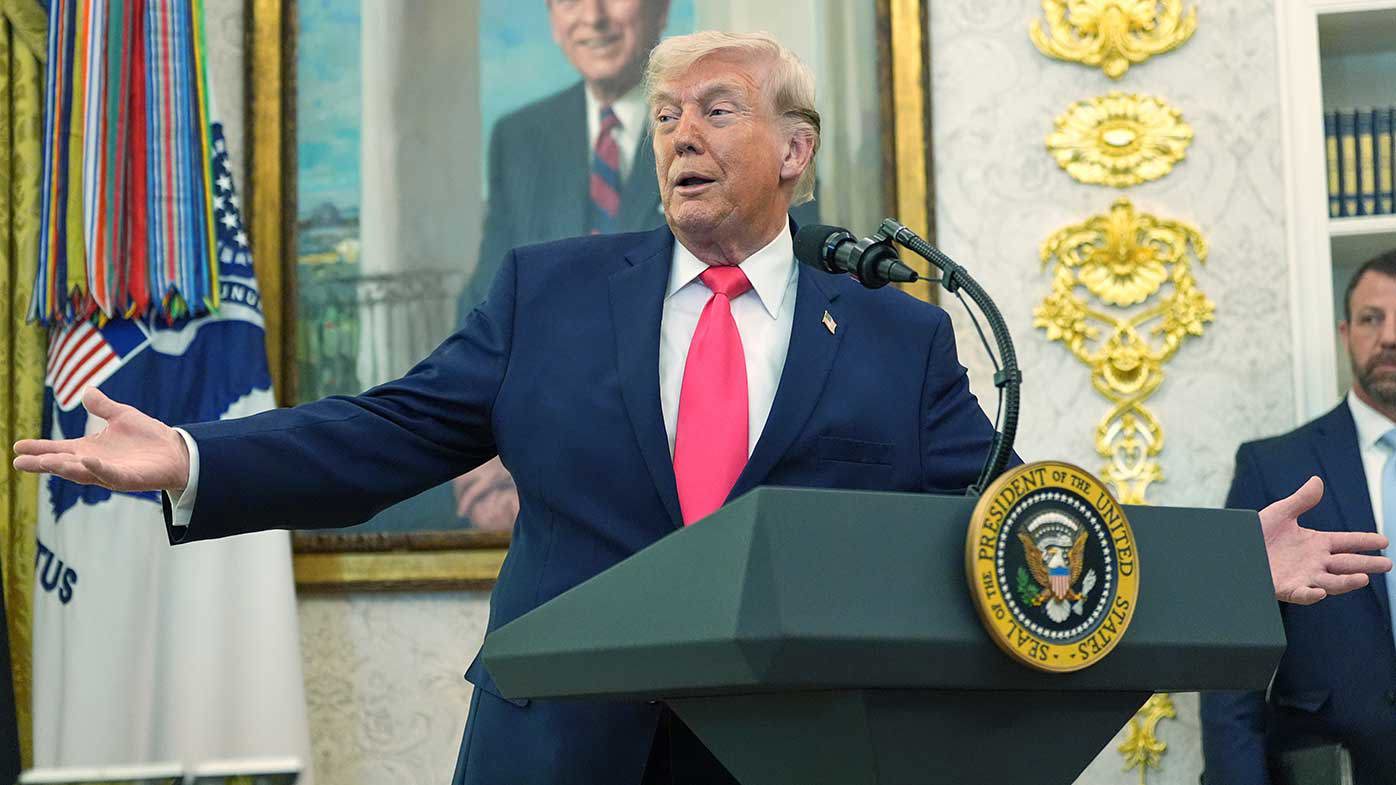
Imagine that trader again. The one in the dark office. The trade is done. The $800 million is committed. They lean back in their chair and wait for the television to flicker to life. They see the podium. They see the flags. They see the man walk up to the microphone.
As the first words are spoken, the trader doesn't listen to the policy. They don't care about the impact on the country, the environment, or the global stage. They are only watching the numbers on their other screen. They are watching their net worth climb by tens of millions of dollars in real-time.
To them, the announcement isn't history. It’s a wire transfer.
There is a coldness in that realization that should keep us all awake. It is the sound of a system being hollowed out from the inside. It is the realization that while we are arguing about the content of the speech, someone else has already sold the echoes.
The $800 million is gone. It has been absorbed into the vast, churning maw of global capital. But the stain it leaves on the idea of a "free market" remains. It sits there, a glowing green reminder that in the halls of power, the most valuable currency isn't the dollar—it's the head start.
The candle of light on the trader's monitor goes out. The office is dark again. The world continues to turn, unaware that it is just a little bit poorer, and a lot more broken, than it was five minutes ago.