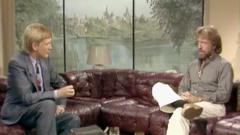
In early 1985, Chuck Norris sat down with BBC Breakfast Time, ostensibly to promote his latest foray into the cinematic jungle. At the time, the world knew him as the stoic, bearded savior of American pride, a man who had transitioned from a world-class martial artist into a bankable pillar of the Cannon Films empire. But that interview was more than a promotional pitstop. It captured the exact moment when the celluloid hero began to eclipse the human being, setting a blueprint for the hyper-masculine, invincible archetype that would dominate the box office for the next decade.
To understand the weight of that 1985 exchange, one must look at the cultural climate of the mid-eighties. The West was obsessed with the idea of the "one-man army." Reaganism was in full swing, and the trauma of the Vietnam War was being surgically repaired through the medium of high-explosive action movies. Norris wasn't just an actor; he was a symbol of corrective history. When he spoke to the BBC, he wasn't just selling a movie like Missing in Action 2: The Beginning. He was selling a specific brand of American resilience that felt both dangerous and comforting to a global audience.
The Transition from Tatami to Tinseltown
By 1985, Norris had already spent years shedding the skin of a professional fighter. The BBC interview highlighted a man who had mastered the art of the soft-spoken warrior. This wasn't the loud, brash charisma of an Arnold Schwarzenegger or the oily charm of a young Burt Reynolds. Norris brought a quiet, almost clerical intensity to his public appearances.
This groundedness came from a legitimate pedigree. Unlike many of his contemporaries who learned to punch for the camera, Norris was a six-time undefeated World Professional Middleweight Karate Champion. He didn't need to act tough; he was the person the tough actors called for training. This authenticity provided a shield against the burgeoning "action star" tropes that often bordered on the ridiculous. When the BBC interviewer probed into his discipline, they weren't talking to a product of a studio system, but a man who had spent decades in grueling physical pursuit of perfection.
The shift from the 1970s "martial arts movie" to the 1980s "action blockbuster" is visible in this era. In the seventies, the focus was on the technique, the choreography, and the art of the strike. By 1985, the focus had shifted to the scale of the destruction. Norris was the bridge. He kept the technical proficiency of the Bruce Lee era but wrapped it in the flags and firepower of the Rambo era.
The Cannon Films Engine
You cannot discuss the Chuck Norris of 1985 without discussing Menahem Golan and Yoram Globus. Their company, Cannon Films, was the wild-west outlaw of the film industry. They realized that you didn't need a complex script if you had a recognizable face and enough squibs to simulate a small war.
Norris became their crown jewel. While the BBC interview focused on the man, the industry was focused on the math. Cannon signed Norris to a multi-picture deal that was unheard of for a martial artist at the time. This wasn't about prestige. It was about volume. They were churning out films that sold in every corner of the globe because violence is a universal language.
The 1985 interview shows a man who seemed remarkably unbothered by the "B-movie" label. He understood his market. He knew that the audience wasn't looking for Shakespeare; they were looking for a moral compass that could kick through a door. There is a specific kind of integrity in that level of self-awareness. He wasn't trying to be something he wasn't, which is perhaps why his popularity has endured long after the pyrotechnics of his peers have faded into kitsch.
The Birth of the Invincibility Myth
It is fascinating to watch the 1985 footage through the lens of modern internet culture. This was decades before the "Chuck Norris Facts" became a global phenomenon, yet the seeds are right there in his demeanor. He projected a sense of absolute certainty. In the interview, he discusses the physicality of his roles with a matter-of-factness that borders on the supernatural.
This invincibility was a calculated part of his brand. In Missing in Action and its sequels, Norris played Colonel James Braddock, a character who was essentially a human tank. He didn't bleed like John McClane would a few years later. He didn't struggle with internal demons. He was a force of nature. This 1985 period represents the peak of the "Unstoppable Hero."
The interviewers at the BBC, typically known for a more reserved and perhaps cynical approach to American celebrities, seemed genuinely intrigued by this lack of artifice. There was no "method" to his acting. He didn't talk about his "craft" in the way a classically trained actor might. He talked about work. He talked about the audience. He talked about the physical toll of the stunts. This blue-collar approach to stardom is exactly what made him the patron saint of the working-class action fan.
The Contrast of the Era
- The Schwarzenegger Model: Built on physique and one-liners.
- The Stallone Model: Built on underdog pathos and physical transformation.
- The Norris Model: Built on stoicism, legitimate combat skill, and moral simplicity.
[Image comparing 1980s action hero archetypes]
The Cultural Impact of the 1985 Persona
What the 1985 interview truly captured was the moment the martial arts star became a political statement. The films Norris was making at this time—Invasion U.S.A. was just around the corner—were deeply reflective of a Cold War anxiety. He was the man who kept the perimeter secure.
Critics often dismissed these films as mindless, but that ignores the psychological utility they served. For a public weary of complex geopolitical tensions, seeing a man like Norris solve the world's problems with a well-timed roundhouse kick provided a cathartic, albeit temporary, relief. He was the personification of the idea that right and wrong were clear, and that right had the bigger fist.
This simplicity is what allowed him to transition so easily into his later career in Walker, Texas Ranger. The foundation laid in 1985—the quiet intensity, the refusal to play the "Hollywood game," the focus on family and traditional values—was so sturdy that he didn't have to change his act for thirty years. He simply let the world age around him while he remained the same.
Behind the Beard and the Ballistics
There is a tendency to view 1980s action stars as caricatures, but the 1985 BBC footage reveals a man who was deeply thoughtful about his position in the industry. He wasn't a pawn of the studios. He was a savvy businessman who understood that his "look"—the beard, the denim, the thousand-yard stare—was a trademark as valuable as any logo.
He also navigated the transition into middle age with more grace than his peers. While others were desperately trying to stay relevant by taking on increasingly "serious" roles or inflating their budgets to compensate for aging bodies, Norris doubled down on his core identity. He knew his audience would follow him as long as he stayed true to the Braddock/Walker archetype.
The 1985 interview serves as a time capsule of an era where a man could become a global icon through sheer discipline and a refusal to blink. It was the last gasp of the "silent professional" archetype before the 1990s brought in a wave of self-referential, ironic action heroes. Norris was never ironic. He was never "in on the joke" because, to him, the values he portrayed weren't a joke.
Assessing the Legacy of the 1985 Moment
Looking back, that specific year was the inflection point. Before 1985, Norris was a rising star in a niche genre. After 1985, he was an institution. The BBC interview wasn't just a conversation; it was a coronation. It verified that his brand of heroism had successfully crossed the Atlantic and was now a permanent fixture of the global cultural consciousness.
We see the echoes of this era today in the way we talk about "toughness." The memes and jokes that surround Norris now are built on the foundation of the man seen in that 1985 footage. We laugh at the "facts" because, on some level, we still buy into the aura of the man who sat on that sofa and talked about combat with the calmness of a man discussing the weather.
The industry has moved on. We now prefer our heroes flawed, neurotic, and draped in CGI. But there is a reason that footage of a bearded man in a simple suit talking to a British morning show still resonates. It represents a clarity of purpose that is increasingly rare. Norris didn't need a multiverse or a dark origin story. He just needed a reason to fight and a clear shot at the target.
The Mechanics of the Norris Brand
The longevity of Chuck Norris isn't an accident of history. It is the result of a very specific alignment of personal history and market timing.
- Authenticity of Skill: He didn't use a stunt double for the things that mattered. The audience could tell.
- Consistency of Character: He never played a villain. He never betrayed the expectations of his fanbase.
- The Middle-American Appeal: He spoke to a demographic that felt ignored by the coastal elites of the film industry.
In the 1985 interview, you don't see a man trying to impress the critics. You see a man who has already won. He has the titles, he has the box office numbers, and he has the respect of his peers. The rest was just noise.
The 1985 BBC interview remains a vital piece of media not because of what was said, but because of what was projected. It was the moment the world accepted that Chuck Norris wasn't just an actor playing a hero; he was the hero we had decided to believe in. That belief has proven to be one of the most durable products in entertainment history.
Study the footage again. Watch the way he sits. Watch the way he answers questions without feeling the need to fill every silence. That is the composure of a man who knows exactly who he is. In a world of manufactured celebrities and fleeting trends, that kind of certainty is the ultimate weapon.
The next time you see a clip of an aging action star trying to recapture their youth, remember Norris in 1985. He didn't have to capture anything. He just stood his ground and waited for the world to come to him.
Would you like me to research the specific box office impact of Cannon Films' 1985 slate compared to major studio releases of that year?