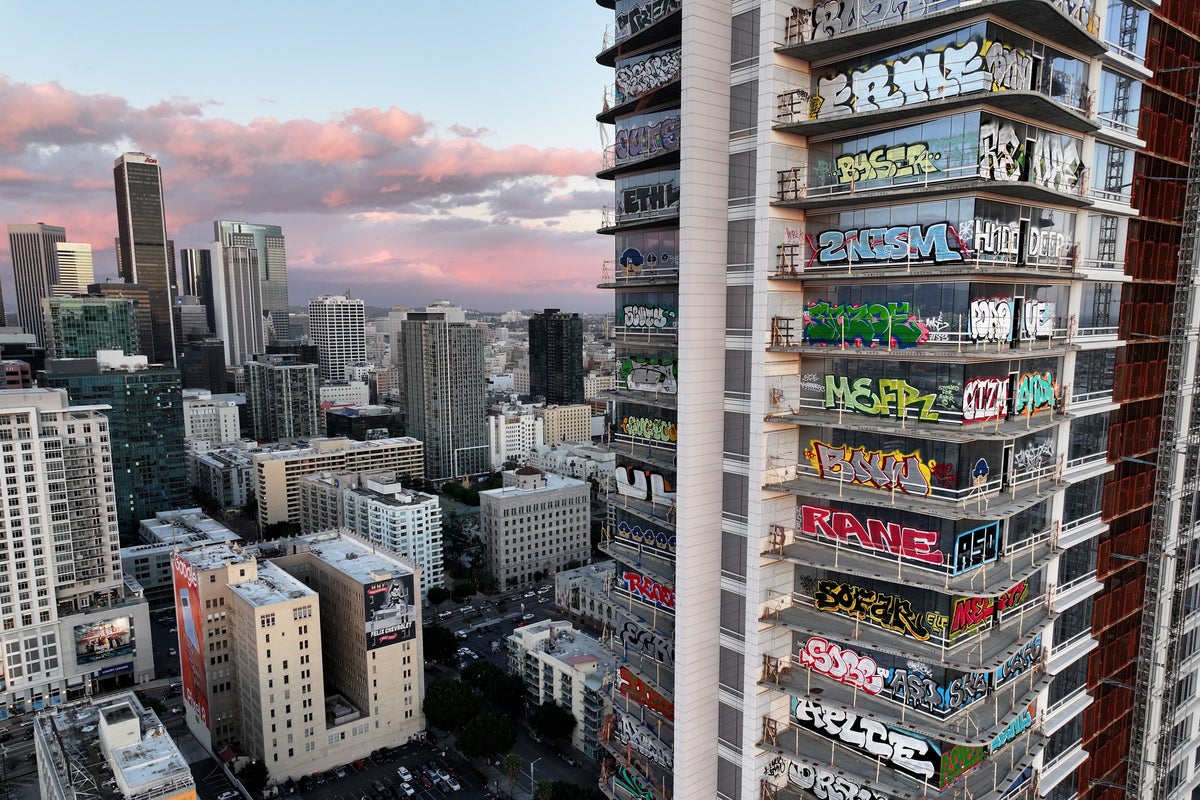
The wind whistles through the 40th floor of Oceanwide Plaza in a way that sounds suspiciously like a sigh. For years, this massive concrete skeleton—three towers looming over the Crypto.com Arena like a trio of abandoned giants—has been the most expensive canvas in the world. It wasn’t supposed to be this way. It was supposed to be a shimmering monument to the new Los Angeles, a $1 billion bet on luxury living, high-end retail, and the kind of glittering urban density that city planners dream about in their sleep.
Instead, it became a tombstone for foreign capital. Then, it became a gallery.
If you’ve driven down Figueroa Street in the last year, you’ve seen them. The "graffiti towers." Thousands of square feet of glass and raw concrete tagged with neon bubble letters, sprawling murals, and defiant signatures. From the street, they look like a fever dream of urban decay. To the artists who risked their lives scaling unfinished elevator shafts in the dead of night, they were a trophy. To the city, they were an embarrassment. To the neighborhood, they were a $1.2 billion question mark.
Now, that question finally has an answer. A joint venture between Colliers and Savills has secured a buyer for the stalled project, marking the beginning of a $1.2 billion resurrection. But this isn't just a real estate transaction. It is a story about the staggering cost of ambition and what happens when a city decides to stop looking away from its most visible scars.
The Anatomy of a Billion Dollar Stall
To understand why this sale matters, you have to understand the sheer scale of the wreckage. Oceanwide Holdings, a Beijing-based developer, broke ground in 2015. They had the money. They had the permits. They had the vision of a "city within a city." But in 2019, the cranes stopped moving. Capital controls in China tightened, the money dried up, and the project sat frozen in time, roughly 60% complete.
Imagine being a construction worker on that final day. You put down your wrench, expecting to pick it up Monday morning. Monday never comes. For five years, those wrenches stayed down. Tools rusted. Piles of expensive Italian marble sat in crates, gathering dust while the glass windows they were meant to be installed behind remained unwashed, then eventually, spray-painted.
The "broken window theory" usually applies to small-scale vandalism, but Oceanwide Plaza offered a gargantuan case study. When a billion-dollar project sits empty, it creates a vacuum. That vacuum was filled by the street. The tagging wasn't just art; it was a physical manifestation of the city’s frustration with a derelict monument to wealth that served no one.
The Human Cost of Concrete
Consider a hypothetical resident of the nearby South Park district. Let’s call her Elena. Elena bought a condo across the street in 2017, lured by the promise of the vibrant promenade Oceanwide was supposed to bring. Instead of a Park Hyatt hotel and luxury boutiques, she spent half a decade looking at a skeletal husk. She watched as the city spent nearly $4 million just to put up fences and clear debris—taxpayer money diverted to babysit a private failure.
For Elena and thousands like her, the announcement of a buyer isn't just a business headline. It’s a return of hope. It’s the possibility that the sidewalk will finally be clear of scaffolding and the shadow over the neighborhood will finally be cast by a living building rather than a corpse.
The logistics of the deal are as complex as a heart transplant. The buyer, whose identity remained shielded during the initial phases of the bankruptcy sale, is stepping into a legal and structural labyrinth. They aren't just buying land; they are buying the responsibility of finishing a vision that someone else abandoned.
Why This Isn't Just Another Building
The $1.2 billion price tag for the renovation and acquisition is one of the largest in the history of downtown Los Angeles. In a post-pandemic world where office towers are losing value and "urban doom loops" are a constant talking point in the media, this investment is a massive vote of confidence. It’s a bet that people still want to live in the heart of the city.
The renovation will have to be surgical. You can’t just paint over the history of the graffiti towers. The new developers face the Herculean task of cleaning thousands of glass panels, some of which may need entire replacement due to the sheer volume of paint and exposure to the elements. They have to re-evaluate the interiors to fit a 2026 market, not the 2015 market the building was designed for.
But the real work is emotional.
The new owners have to convince Los Angeles that these towers belong to the city again. There is a delicate balance to strike here. If they scrub it too clean and make it too exclusive, they risk alienating a community that has lived with this eyesore for years. If they don't do enough, it remains a reminder of a failure.
The Invisible Stakes
Behind the spreadsheets and the escrow accounts, there is a pulse. This project represents over 2,500 potential units of housing and a massive influx of jobs. During the construction phase alone, the site will swarm with hundreds of electricians, plumbers, and carpenters who have been waiting for this "game-on" signal for half a decade.
When the lights finally flicker on in the upper floors of those three towers—not the flashlights of trespassers, but the steady glow of kitchens and living rooms—the skyline of Los Angeles will change. Not just visually, but psychologically.
The story of the graffiti towers has been one of neglect. It was a story about what happens when global finance forgets about local impact. This new chapter is the correction. It’s the moment the city stops being a backdrop for a cautionary tale and starts being a place where things actually get finished.
As the new developers move in, the spray paint will disappear. The neon "tags" that defined the L.A. skyline in 2024 will be washed away by industrial solvents and replaced by the reflection of the California sun. Some will miss the raw, chaotic energy of the painted towers—the way they stood as a middle finger to the polished corporate world. But for the people who walk those streets every day, the sound of a nail gun is a much sweeter melody than the hiss of a spray can.
The giants are waking up. They are shedding their colorful, vandalized skin and preparing to join the city they were always meant to overlook. The cost was high—$1.2 billion and five years of silence—but the price of leaving them as ghosts was even higher.
In the end, a building is just steel and glass until someone decides to care about it. For the first time in a long time, someone finally does. The sighing wind on the 40th floor is about to be drowned out by the sound of hammers.