The air inside the crew quarters at Kennedy Space Center doesn't smell like the future. It smells like industrial floor wax and filtered oxygen. Somewhere in the distance, the Atlantic Ocean crashes against the Florida coast, indifferent to the four human beings checking their seals and mentally tracing the path of a four-million-pound explosion.
We talk about Artemis II as a "mission profile." We discuss the Space Launch System (SLS) and the Orion capsule. But for Reid Wiseman, Victor Glover, Christina Koch, and Jeremy Hansen, the reality is much tighter. It is the size of a small SUV. That is the space they will inhabit for ten days as they become the first humans to flee the gravity of Earth since 1972.
For over fifty years, we stayed close to home. We built the International Space Station, a magnificent laboratory circling just 250 miles above our heads. It was safe. It was familiar. If something went wrong, you could be home in a few hours. Artemis II changes the math. These four souls are heading 230,000 miles away. They are going to the far side of the Moon, further than any human has ever traveled, to stare into the blackness of the deep solar system and see if we still have the stomach for it.
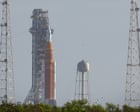
The rocket itself is a monster of physics. The SLS is designed to generate 8.8 million pounds of thrust. To put that in perspective, imagine the power of 160,000 Corvette engines screaming at once. When those twin solid rocket boosters ignite, the vibration doesn't just rattle your teeth; it moves your internal organs. It is a violent, controlled detonation that fights the very fabric of our world to break free.
But the real story isn't the fire. It’s the silence that follows.
Once the roar of the engines dies away and the first stage falls back to the ocean, the crew will find themselves in a high Earth orbit. This isn't just a sightseeing tour. They have work to do. They will perform a proximity operations demonstration, essentially a high-stakes dance with the spent upper stage of their own rocket. They need to know, with absolute certainty, that they can manually pilot this craft. If the computers fail over the lunar horizon, it’s just four people and a joystick against the vacuum.
Think about the vulnerability of that moment.
They will spend the first 24 hours testing life support. Can the scrubbers handle the carbon dioxide of four breathing adults? Does the water recycling hold? This is the "checkout" phase. If anything flickers, if a seal breathes a whisper of air into the void, they can still turn back. They are tethered to us by a long, invisible thread of physics.
Then comes the burn.
The Trans-Lunar Injection is the moment the thread snaps. Orion will fire its engine, pushing the crew out of Earth's orbit and toward the Moon. At this point, there is no quick U-turn. They are committed to a free-return trajectory. They will swing around the Moon, using its gravity like a cosmic slingshot to whip them back toward Earth.
Christina Koch, who already holds the record for the longest single spaceflight by a woman, isn't just going for the data. She’s going as a pioneer for every person who ever looked at the Moon and thought it was a place for "them," not "us." Alongside her, Victor Glover becomes the first person of color to leave low Earth orbit. This isn't just about diversity metrics. It’s about the fact that when we go back to the Moon to stay, we are sending the whole of humanity, not just a narrow slice of it.
Life inside Orion is a study in forced intimacy. There are no private bedrooms. There is no shower. There is a small galley, a compact toilet, and the constant hum of electronics that keep them alive. They will eat dehydrated meals and sleep in sleeping bags tethered to the walls so they don't drift into a control panel.
The heat is another factor. Space is a place of extremes. On one side of the capsule, the sun beats down with a relentless 250 degrees Fahrenheit. On the shadow side, it’s a soul-crushing 250 degrees below zero. The spacecraft has to rotate slowly—what engineers call "barbecue mode"—to bake evenly and keep the internal temperature stable.
As they approach the Moon, the scale of our existence shifts. The Earth, which usually fills the entire sky for astronauts on the Space Station, will shrink. It will become a marble. A bright, fragile blue marble that you can hide behind your thumb. This is the "Overview Effect" on steroids. It is the realization that every war, every triumph, every heartbreak, and every sunset you have ever known is happening on that tiny, distant speck.
The Moon will loom large. It isn't the soft, romantic glow we see from a backyard. Up close, it is a battered, ancient corpse of a world. It is scarred by billions of years of impacts, covered in a fine, abrasive dust that smells like spent gunpowder. The crew won't land—Artemis III will handle that—but they will see the craters of the lunar south pole with their own eyes. They will scout the territory where future lunar bases will sit in the "peaks of eternal light," spots where the sun almost never sets, providing constant power for the first human colonies.
Then comes the dark side.
When Orion passes behind the Moon, all communication with Earth will cease. For approximately thirty minutes, the crew will be more alone than any humans in history. No radio. No mission control. No frantic tweets or reassuring voices from Houston. Just the four of them, the ticking of the clock, and the vast, indifferent stars. This is the psychological threshold of the mission. It is the moment we stop being a planet-bound species and truly become explorers of the deep.
The return journey is a three-day fall back to Earth. Gravity begins to win the tug-of-war. Orion will accelerate, hitting the atmosphere at 25,000 miles per hour. This is where the heat shield, a thick layer of ablative material, earns its keep. It will endure temperatures of 5,000 degrees Fahrenheit—half as hot as the surface of the sun. The air outside the windows will turn into a screaming wall of plasma.
If the heat shield holds, three massive parachutes will bloom over the Pacific. The capsule will splash down, bobbing in the waves like a cork. The recovery teams will be waiting, but the people who step out of that hatch won't be the same ones who climbed in.
We often ask why we do this. Why spend billions on a rock in the sky when we have problems here?
The answer isn't in the rocks or the regolith. It’s in the challenge. We are a species that thrives on the edge of the impossible. We need to see what’s over the next hill, even if that hill is a lunar crater. Artemis II is the bridge. It is the proof of concept for the Gateway station, for the permanent lunar base, and eventually, for the three-year journey to Mars.
The mission is a rehearsal for a future we almost forgot how to imagine. It reminds us that we are capable of more than just managing our own decline. We are capable of reaching into the dark and bringing back a piece of the light.
When the SLS finally clears the tower, the vibration will be felt for miles. People will cheer. Some will cry. But the four people at the top of that stack won't be looking back at the fire. They will be looking up, waiting for the moment the sky turns black and the stars stop twinkling, signaling that the door to the rest of the universe has finally been kicked open.
The Moon is no longer a destination. It is a doorstep.
Ten days in a tin can. Twenty-four million miles of vacuum. Four heartbeats. One giant leap that we are finally ready to take again.